
Originally published on the AdDogs blog — read the source with the full 20-tool table, FAQ, and footnotes.
Five categories, one decision
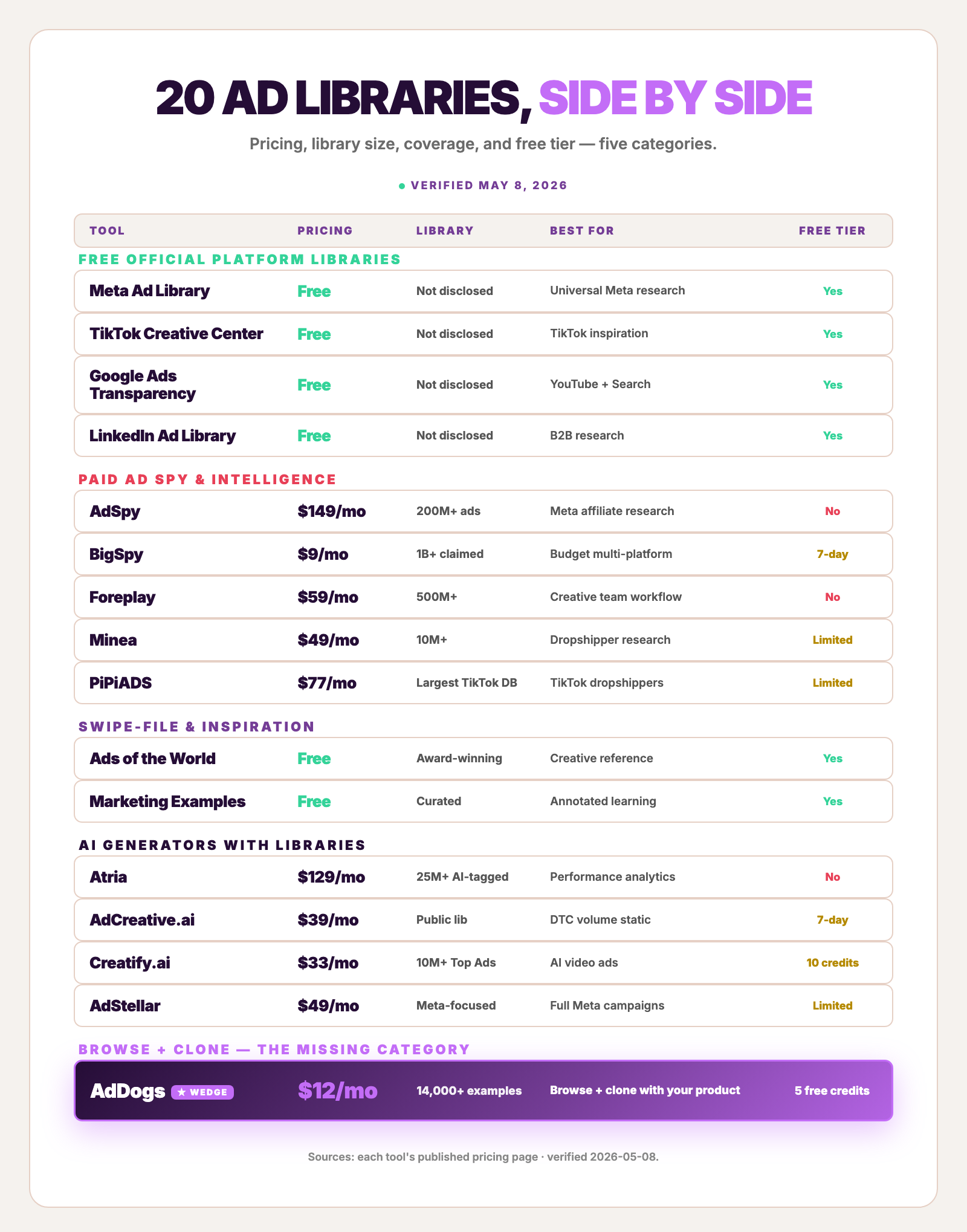
There are five kinds of ad library: free official platform archives (Meta, TikTok Creative Center, Google, LinkedIn, Pinterest), paid spy tools (AdSpy, BigSpy, Foreplay, Minea, PiPiADS, AdHeart and more), curated swipe files (Ads of the World, Marketing Examples, Cannes Lions), AI generators that ship a library too (Atria, AdCreative, Creatify, AdStellar), and the newer browse-and-build category.
The decision between them isn’t size. Per Logical Position citing AppsFlyer, 70–80% of Meta ad performance now traces to creative. So the question is never “which has the most ads” — it’s “what will I do with one once I find it.” Researching a competitor, building a swipe file, and shipping a finished ad are three different jobs, and no single tool wins all three.
The free tier you’re probably skipping
Anyone who pays for a spy tool without first working the free libraries is paying twice.
The Meta Ad Library shows every live ad on Facebook and Instagram — but no spend, no CTR, and crucially no way to filter by how long an ad has been running. TikTok Creative Center is the only free place TikTok’s own algorithm tells you what it’s rewarding right now. Google’s Ads Transparency Center covers Search and YouTube if you already know the advertiser’s name. LinkedIn’s Ad Library is the cleanest view of B2B copy — LinkedIn converts about 6× better than other platforms for B2B — but you have to visit each company page by hand.
Two to actively skip: X’s “Ads Repository” is so broken the EU fined X €120 million in December 2025 over it, and Snapchat only runs a political-ads library. Neither is useful for commercial research.
Paid tools fix the filters, not the finish line
The paid category exists to fix one thing free libraries can’t: historical depth, keyword search, and run-duration filters. AdSpy ($149/mo) is the Meta gold standard with 200M+ ads. AdHeart ($53/mo) indexes 900M+ Meta creatives at a third of the price. Foreplay ($59/mo) is the swipe-file workflow most agencies build around, with the highest verified rating in its category (G2 4.8, n=115). For dropshippers, Minea and PiPiADS index the product surface aggressively.
But notice where even the best of them stops. As 1800DTC wrote about Foreplay: “the platform helps you find inspiration but leaves the crucial step of actually making a new one entirely to external resources.” Every spy tool teaches the workflow up to “save and organize.” Past that, you still need a designer — and a calendar.
Run-time is the only honest filter
Here’s the signal native libraries refuse to expose: how long an ad has actually run. It’s the closest thing to a public proof of performance, because losing ads get killed and winners get left alone.
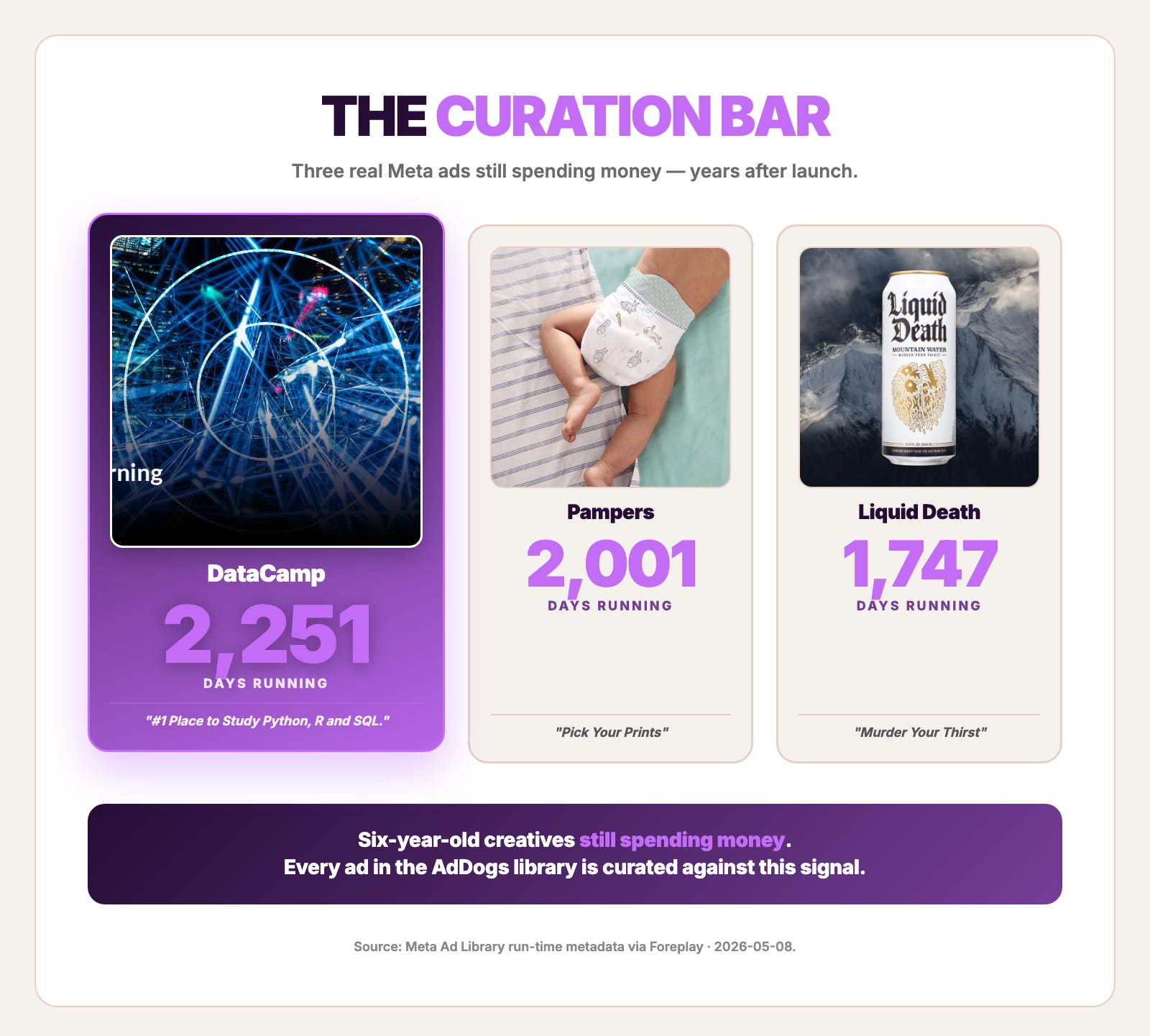
DataCamp’s static: 2,251 days. Pampers’ “Pick Your Prints” subscription bundle: 2,001 days. Liquid Death’s “Murder Your Thirst” long-copy static: 1,747 days. The market curated these, not an awards jury — someone kept paying to run them year after year. Model against those, not against whatever’s trending this week.
And the question every brand owner asks before modeling a competitor: recreating an ad’s layout is legal. Their logo, trademarks, and exact copy are not. Rebuild the structure, bring your own everything else.
The number that should drive the decision
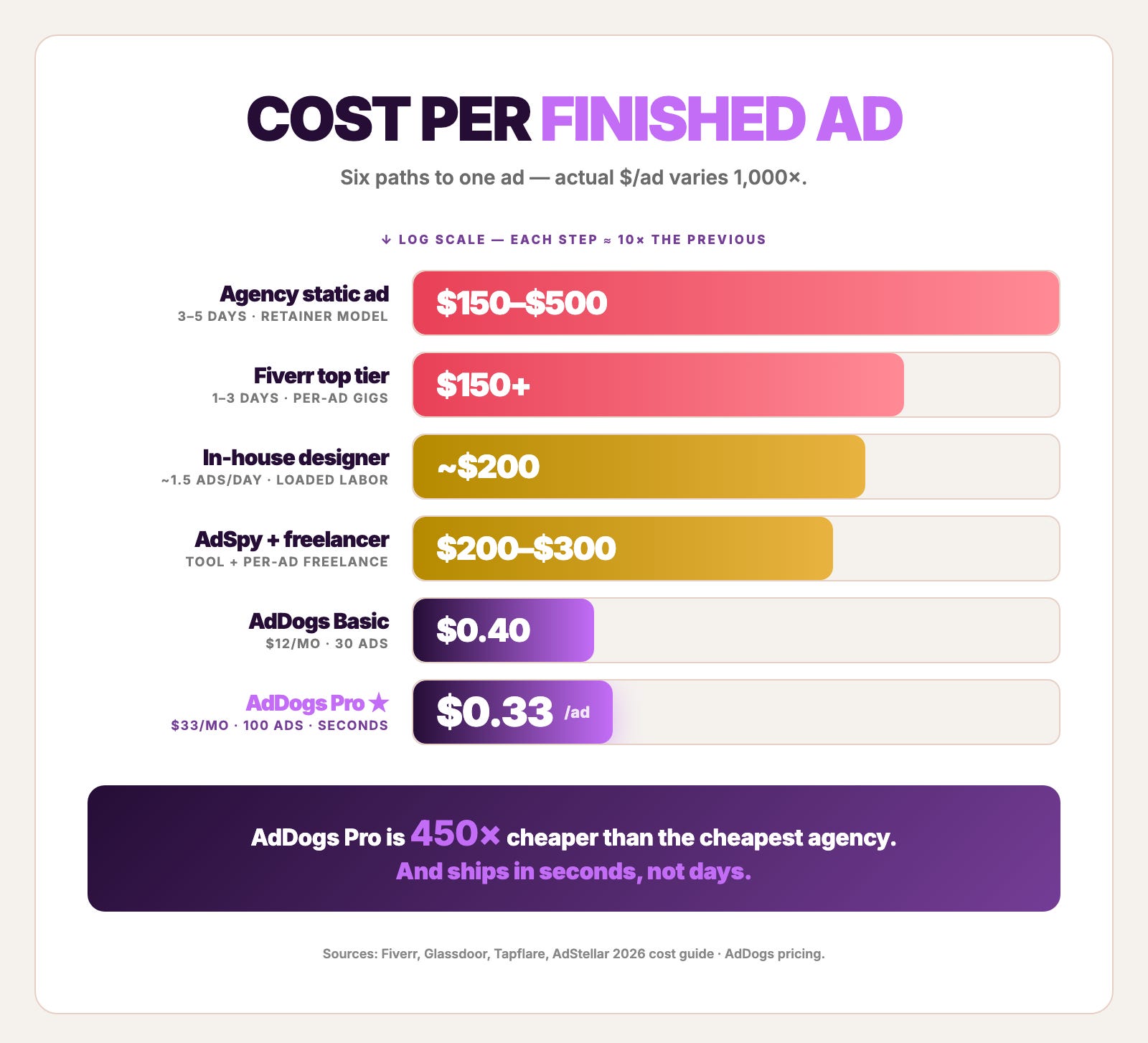
Every library above is an input. The output is a finished ad — and that’s where the cost actually lives. It varies more than 1,000× across the paths operators consider.
DIY in Canva is free but eats ~30 minutes each. A Fiverr freelancer runs $40–$150+ per ad over 1–3 days. An in-house designer lands near ~$200/ad in loaded labor. An agency static ad is $150–$500 and 3–5 days. AI tooling drops it to cents and seconds.
The library you pick is cheap. The path from “found it” to “shipped it” is where the entire budget hides.
The deficit is structural. A $4,500/mo agency retainer ships about 15 ads; top DTC brands run 50–100 a month. That 35–85 ad gap, every month, is the whole game — and it’s a math problem about cost-per-finished-ad, not a shopping problem about database size.
The bottom line
Pick by the job: AdSpy or AdHeart for Meta depth, Creative Center plus PiPiADS for TikTok, Foreplay for team workflow, Minea for dropshipper discovery, Marketing Examples for craft. But run the cost-per-finished-ad math before you run the database-size comparison — because finding the ad was never the expensive part.
Hit reply with the library we got wrong, or the one we left off. We read every reply.
AdDogs is the ad-cloning tool for operators who’d rather start from a winning reference than a blank canvas — point it at a competitor’s ad, swap your product in, ship in seconds. We wrote this survey because every other “best ad libraries” list ranks on database size and stops at “now you have a tool to find ads” — the half of the problem that was never hard. The full version, with the 20-tool table and FAQ, lives on the AdDogs blog.